
A useful strategy but conditions apply
When I joined as sub-collector Jajpur, my first posting in August 1982, I was full of various theoretical ideas learnt at Mussoorie as well as at IIT Bombay, my alma mater. My handling of the annual festival of Goddess Biraja using PERT-CPM techniques with information shared in Odiya, had already gone well with the people. As a matter of fact, my being posted to Jajpur as a young direct recruit after a gap of almost 15 years was considered as a matter of pride by the general public in Jajpur. Mr R M Senapati, posted there in 1967 was a legend and so was Shri Raghu Mishra a promoted IAS officer who was very effective, but posted there during the Emergency, as many people would observe. Me the ‘young lad’ would therefore be judged against the benchmarks set by these two officers. So, people were waiting to see what new ‘technique’ emerges from my stock. One such technique was to use ABC analysis which in plain English means separating the smaller number big fish which account for major part of a problem and separate them from the large number of small fish which account for only a ‘small change’.
Jajpur was, and continues to be notorious for its very clever and legally aware people. Legend would have it that even the legendary Shravan Kumar, devoted son who was carrying his blind parents on his shoulders for pilgrimage in a Kanwad, rebelled against them while crossing Jajpur. His devotion returned as soon as he exited Jajpur. Legend will also have it that people would sleep with their left thumb firmly covered lest someone takes the left thumb impression and file a case against them. In my humble opinion many areas of Odisha have quietly overtaken the much-maligned Jajpur!
However, the notoriety I was concerned with, was of a different nature – collection of the land revenue. Traditionally, in post-independence India, a district administration was always judged by the land revenue administration and maintenance of Law and order. Collection of Land Revenue as taxes and maintenance of land records well always had a premium. More importantly, this performance was a part of the annual assessment and one had heard of many a career having faced the ‘air pocket’ of bad appraisal on this count. I did not want to face similar situation.
Land revenue collection in Jajpur used to remained pegged below a mask of about 35% which had not improved ‘even during the emergency’ as I was told. Collector Cuttack, Mr Harmohan Pattnaik, my boss then had forewarned me. You have a tough task on hand.
The ABC philosophy did help. I had the habit of touring quite a lot – particularly areas which were difficult to reach and also areas between two administrative boundaries that usually receive less attention. My visiting these areas had already spread the word around that I can land in any field offices unannounced. This had put people on alert. In addition, I had the habit of sitting in the field offices for long hours, such as those of revenue inspectors and go through their records, working conditions and ask for their suggestions to improve the working of the administration. I quickly realized, that a significant part of the land revenue arrears was on account of the ‘big fish’ – influential people who could afford to pay the taxes but would not. They will wait for the natural calamities, floods was a recurring feature in Jajpur, and then seek concessions and waivers from government. The smaller land owners, much large in number accounted for small amount of the taxes and arrears.
I therefore thought it to be a good idea to take a look at the top few defaulters in every RI area. Each RI was asked to prepare a list of the top 10 defaulters and keep a list of the next ten ready. Jajpur luckily did not have the problem of vacancies or absenteeism. So, most posts were filled and the hierarchy of revenue supervisor and Tehsildar the two layers above the RI were in place and functional. The Supervisors were told to focus only on the 20 persons during their field visits. The Tehsildar would then focus on the ones still not paying their taxes. Finally, me - the sub-collector, would like to have a conversation with the recalcitrant land-owners during my field visits.
I also made it known that I will like to have the background of these influential people – if they were in regular jobs, were school teachers, contractors, business people and if they had any matters needing approvals or any other consideration at sub-divisional level. The subtle message was not lost on the audience – if they did not pay taxes, this will be factored in while dealing with their cases. There was no way you would be an A class contractor registered with the Government and continue to be a land revenue defaulter!
This was a very different approach from the traditional one. First, it reduced the drudgery of the revenue functionaries. Second, many smart land owners found it to be a good idea to pay up part of the taxes, just to remain below the list of top 20. This will avoid their visibility but our revenue collection would still buoy up. However, as soon as this happened, the list of fresh 20 land owners would become known and again they will like to avoid being in that list. This led to a virtuous cycle. More interestingly, the smaller fish, seeing the ‘influential’ people paying up the dues, also started to pay up.
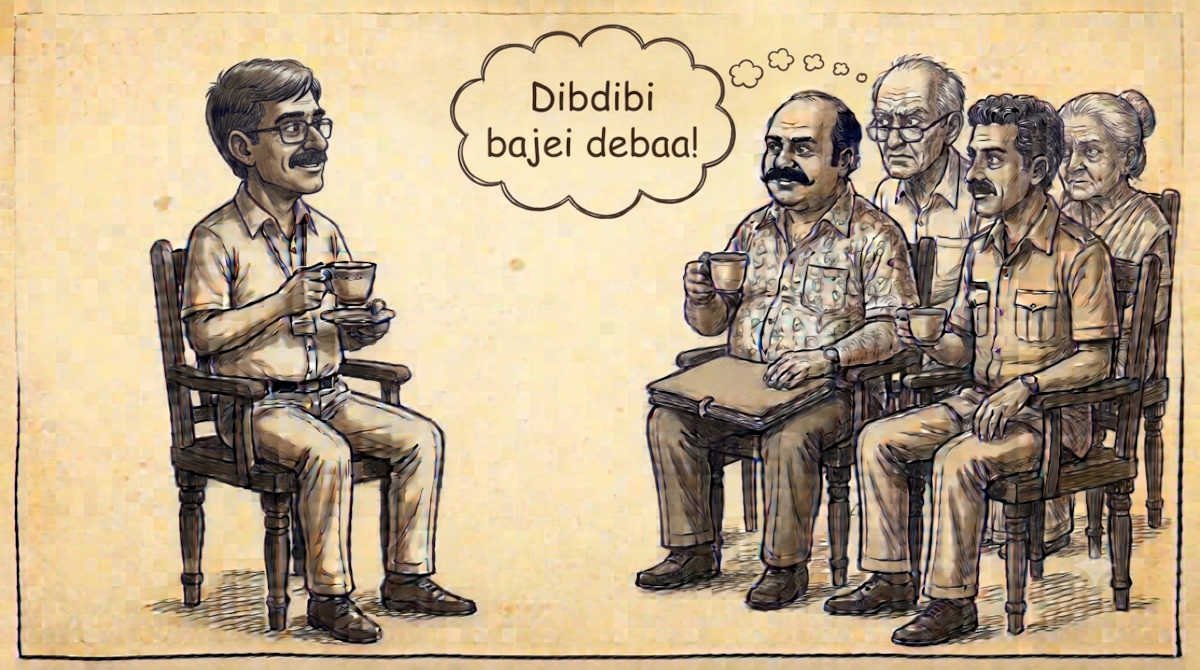
One interesting case was of a cantankerous opposition party MLA whom everybody was careful with. It’s a different matter that he later became quite friendly. I had told him that both of us were hot-heads, but I was representing the state and had no personal stake. I could as such escalate an issue using my executive powers if he was on the wrong side. If he were not, it was my duty to take his suggestions even if he was in the opposition. This went well with him, and he was quite appreciative of my even handedness. However, his father was not all that convinced about our cordial equation which he considered fragile in any case. So, he quietly got in touch with the RI and paid up half the amount due so as to avoid any ‘confrontation’. If push did come to the shove, the British had kept provision where the name of the defaulted could be announced in the village with a beat of drums in front of his house. This provision lingered on in the Colonial India. Although I considered it quite anachronous, old people did express the apprehension that this ‘ young lad’ would resort to it – the Odiya term “Dibdibi bajai debaa.” I had absolutely no such intension; the symbolism of the young Sub-collector having a very cordial meeting with the top 10 defaulters over a cup of tea was a good enough deterrent. They would have loved my visit for an occasion or a social purpose, but this was a no no.
An additional twist was my message that I will judge the effectiveness of all the Supervisors and the Tehsildars by how well they have dealt with the big fish, rather than their overall ‘hard work’. My message was clear, work smart, not hard.
The strategy worked. In the annual review, the Jajpur Land Revenue collection jumped to 64%, way above what was collected ‘even during the Emergency’. The Collector was suspicious. While taking me to his home for lunch after the review meeting, he asked me what did I exactly do. The MLA story had apparently reached him. I assured him that I had played fairly, just shifted the focus on the big fish. He guffawed. For next year this strategy was adopted in the entire district.
[PS - Conditions apply: I have later used this technique quite effectively in other regulatory jobs, particularly as the Administrator of a District Cooperative bank. But let me put a caveat – conditions apply. Here is the case of one Chairman of the State Electricity Board – an upright, fearless officer who also tried to do something similar. Having failed to persuade the habitual defaulters, he hit upon the idea of publishing the name of the top 20 defaulters of the electricity dues in the newspapers. However, in an unguarded moment, he disclosed it to one of the very senior officers in the early afternoon. Unsurprisingly, the information reached the topmost defaulter – an influential Industrialist. The same evening, the much pending application of the officer for Central Deputation to Government of India was approved post haste, concurrence of Government of India obtained immediately, and posting orders issued directing him to relinquish the charge with immediate effect. As they say clear weather air pockets are difficult to spot and are more dangerous!]