
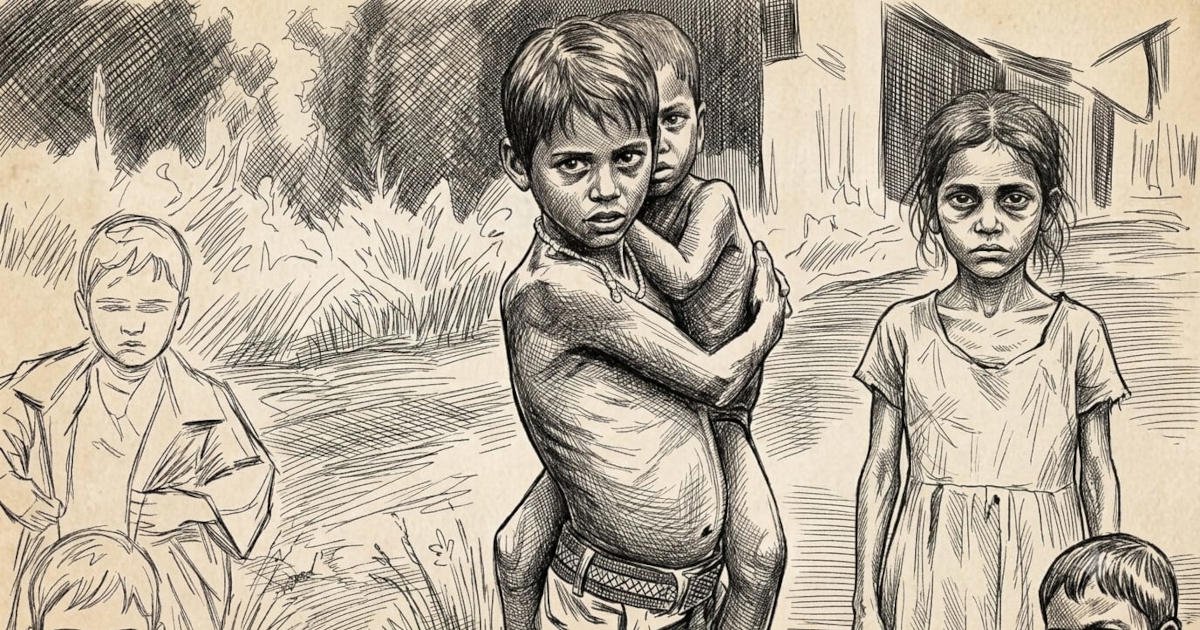
A Vikasit Bharat is a Bharat where every child is healthy and bubbly. An undernourished child cannot play with the lion cubs as the legendary King Bharat did. How do we reach there again?
Persistence of child undernutrition in our country remains a perplexing issue. It has not kept pace with our economic growth and even with the improvement in child mortality. There is reduction in the levels of undernutrition no doubt – but the pace is tardy. The adage, “Vikas ho to raha hai, par usme gati nahi hai” used in a different context, is equally applicable here.
This picture is confounded by the fact that ICDS and its subsequent avatars, the Nutrition Mission and the Poshan Abhiyaan, have been around for over 4 decades now. Additionally, the improvement in the nutritional levels has been uneven – some states competing with the first world while some competing with Sub-Saharan Africa. How do we ensure a rapid and even reduction in levels of undernutrition? There is a clear need to reboot. Some green shoots of this have already been recognized by the Government – convergence between various sectors (health, sanitation, food security, and livelihoods) with the child nutrition programme is one. Convergence between different stakeholders—government, civil society, responsible corporates, philanthropists, and academia—is the other crucial link.
How do we string these together and what do we prioritize? I call it walking on both the legs. Look at those closest to the goalpost and help them reach it. Identify, cross-check, and recognize them. Every state has its best foot forward—a Rudraprayag here, a Jagatsinghpur there, a Kollam here, a Longding there. Put all your might there and make them Kuposhan Mukt. After all, a Kuposhan Mukt Bharat needs a Kuposhan Mukt state, which in turn needs a Kuposhan Mukt district, and so on. Do this to the two best districts in each state and two best projects in each district. Results will follow and huge learning will be created.
At the same time, identify those at the deepest end of the pool and help them out of it. An adolescent girl with BMI below 16, a teenage pregnancy, a mother with 2nd trimester Hb level below 7, VLBW child (< birth weight below 1800 gm). Don’t claim that they don’t exist, claim that they are not unattended. Create a ‘minimum wellness programme’ – a la the minimum needs programme in the 60s and 70s for physical infrastructure. This will be a programme for the human capital. This is where the Corporates and the Civil Society has a role. Put your efforts in prevention rather than the cure. True, prevention does noy give you the TRP cure does. But your communication strategy can do what Ernakulam district did in the Saksharata Abhiyan – made itself 100% literate – firing the imagination of all 500 odd districts in the country. We can have a low BMI -Mukt district or a district where no pregnant woman has 2nd trimester Hb below 9 and so on. This will create a pool of best practices.
The third strategy is to help the maternal and child nutrition programme from outside the sector. Use anti-poverty programmes to get the household out of the ‘poorest’ quintile into just the ‘poor’ quintile. The dividend in terms of nutritional status is huge. The mother does not need our circulars and sermons then. Hence, I would strongly recommend providing all women in the poorest category households 150 days of work under VBGRAM-G. The results will surely please Lord Ramji – the blessings of the mothers will be an additional bonus. Nandurbar district has taken an initiative in this regard.
Literature is clear—what matters is the mother’s resource base, awareness, and her agency to decide in favour of her children. This is a tripod. Don’t ask which leg can afford to be short. The tripod imbalances.
Lastly, we need to think differently for urban children. The traditional ICDS structure, essentially of rural origin, will simply not deliver in the urban segment, and we are urbanizing fast. Maharashtra has done restructuring of the urban ICDS programme. Others could learn from it.
I will quote by giving a common adage in Odisha – no one can drag the Chariot of Lord Jagannath alone. All have to join the efforts. Reducing child undernutrition is similar – all of us have to do it together in convergence. Only then the three children—Jagannath, Balabhadra, and Subhadra sitting on the chariot—will be able to reach their destination well beyond the abode of their ‘Mausi Maa’: the abode of a Kuposhan Mukt Bharat.