
Case of Driving license computerization in Odisha
I was shifted from the position of Secretary Women and Child Development and posted as Transport Commissioner, Odisha. One reasons of this shift was my strong difference of opinion with the Minister on certain matters. So, she got me transferred. It was done with the blessing of Shri Pyari Mohan Mohapatra the Advisor to the CM. who had always been very affectionate towards me and Anita; my wife and batchmate, right since my entry into the service. But he also used to get angry at times with my candidness or what he would view as insolence! So, he decided to give me a 'zor kaa jhatka – dhire se'.
The transfer sent three signals simultaneously. Moving me out of the Secretariat to bring my rating a notch down in the power hierarchy. Shifting me from the position of a Secretary to a 'Head of the Department' post i.e. Transport Commissioner was another snub. I would now have to report to Secretary Commerce and Transport. The third was to move me to a Department Headed by a Minister of State rather than one headed by a Cabinet Minister.
I was unfazed as unfazed could be. The Minister was very happy to have me as a Transport Commissioner and said this in so many words to the Secretary. When I first called on him, he said he was looking for only two things from me 'Kaam' (work) and 'Sunaam' (good image). This was music to my ears as a bureaucrat. We did gel very well, even though my tenure was quite eventful, but that will be narrated in another episode.
One opportunity for the combination of Kaam and Sunaam presented itself when the Central Government pushed for computerisation of driving licenses and vehicle registration under its two suites — 'Sarathi' for driving Licenses and 'Vahan' for Vehicle registration. The technical specifications were drawn and vetted by a technical committee. It did benefit from the expertise of Prof Rajat Mona of IITK and enthusiastic push by Alok Rawat, then Joint Secretary in the Ministry. I attended a two day workshop at Delhi and charged by Alok Rawat's exhortations, decided that we should implement this scheme in Odisha.
For Odisha, this was bit of an audacity. The implementation of the scheme had faced rough weather in a couple of states. Jharkhand had awarded a tender where the cost came to Rs 104 per license; soon to become unworkable. For Delhi the cost came to above Rs 250-/. But I decided to take a plunge.
I had a good technical team led by Er Sarada Mohapatra and the RTO of Bhubaneswar, Mr Senapati who had earlier worked in private sector (with TATAs if I remember correctly). The Minister was supportive, the Secretary was content in going by my judgement (Tum to IIT Bombay se padhe ho naa!) and the ambience of reforms was in the air during the Naveen Pattnaik era. But I also wanted to send a clear message about transparency and level playing field. So we drafted a good technical document calling for the bids, and held a technical presentation session and a pre-bid conference. Our technically sound, firm and clear answers did set the tone for discussions.
Many smart bidders ask for an elbow room to seek clarifications by mail later. I was clear; all queries will be collated together, querists anonymized and all answers will be shared with all bidders. This had a very positive impact. Further during the coffee break, I did mention, almost deliberately to a number of the bidders that no one in the hierarchy, myself, the Secretary, the Minister or the Chief Minister had any interest in making any money from the bid. The bidders were therefore to factor this in while bidding. Some believed me, some did not, but at their own peril as we will later see.
The show off about my penchant for transparency continued. After receiving the bids, the steel trunk was kept in one of my offices in Bhubaneshwar while the keys were with Er Mohapatra – a fact made widely known. The final bid opening, was done in the conference room of the WCD Department – a neutral venue. All bidders were present and accommodating small errors in the documents was done with the consent of all.
When the financial bid was finally opened, we were in a state of disbelief. The lowest three bids were in a narrow band of Rs 66-68, the next was Rs 100+ and others were further above. This was a pleasant surprise. We asked the L-1 to confirm the amount. But I did throw a spanner. While the tender specifications asked for a 16KB chip the market had already moved to a 64 kB chip – a fact that both me and Er Mohapatra new and grasped its implication. But negotiation for 64 kB now would have been open to challenge by other bidders. I literally blackmailed the L-1. "Why don't you give us the smart card with 64 kB chip voluntarily , now that you are the L-1? Then others cannot object, but if you don't we my need to rethink the bid and call for fresh tenders." There was some humming and hawing, but the bidder quickly saw the point. We got a confirmation by fax within an hour, thanking us for the opportunity and offering a 64 kB chip without any extra charge.
Still, we formally needed the Minister's approval. "A change was a change", said the Secretary "and the Minister must approve".
I went to the Minister, gave him the good news of low L-1 to L-3 band which actually meant that the state will be saving money for every license instead of having to give some subsidy. "However Sir, I wanted to have your approval for one technical change. We are asking the bider to give a 64 kB chip instead of the 16 kB specifying in the tender."
"Change the technical specifications? Agyaa, you know how particular the CM is about all these matters. Why do we need to change? 16 kB hai to 16 kB hai." Being from Sambalpur, he will once in a while break into Hindi.
"It's like this Sir, we are getting an exercise book with 16 pages. Now the vendor is offering a 64-page book on his own. We have nothing to lose. The card will run longer, can store more details." I was at my charming best. This appealed to the Minister. He granted approval.
Finance Department was cautious. "Is this workable L-1? Jharkhand failed at Rs 104"
I told the AS, who had lot of trust in me given my past record, that if L-1 and L-2 were far apart, like in Jharkhand, the apprehension was warranted. But here the L-1 to L-3 were in such a narrow band. If L-1 failed, the other two will happily jump in, to match it.
This made sense, and in any case, the Finance was saving money per license.
We then really slogged. My view was simple, now that the contract was awarded, it was incumbent upon the Transport hierarchy as well to make it a success. I took some unorthodox steps. Often our technical meetings and review meetings would happen in my car journey from Bhubaneswar to Cuttack. Mr Senapati, the techno savvy RTO Bhubaneshwar got the first training and ran the scheme well for a month. After that every RTO was literally deputed formally to his office for training for one day and on the next day, delegated with powers to actually sign the approval. I visited each RTO office finalizing the work plan and the layout. In one case, the spacious old British style bathroom of one RTO office was taken over and repurposed as the IT room. Most RTOs and ARTOs had a soft corner for me thanks to my IIT Bombay background and I got full support.
I also did a PR by calling on the Hon'ble Chief Justice and requesting their Lordships to make it convenient to come to the RTO's office in lots of two or three, grace our IT room and be given the License right there. This did work well and we warded off any judicial recourse by different interests. The Secretary congratulated me for my 'cunningness'.
The NIC acclaimed our roll out as the fastest and technically sound. The proof of the pudding was the smooth transition when three new RTOs were created.
I met a failed bidder one day at Kolkata airport. After the usual namaskar etc. he heaved a sigh and said "Sir, aapki baat maan lete to achahha hotaa."
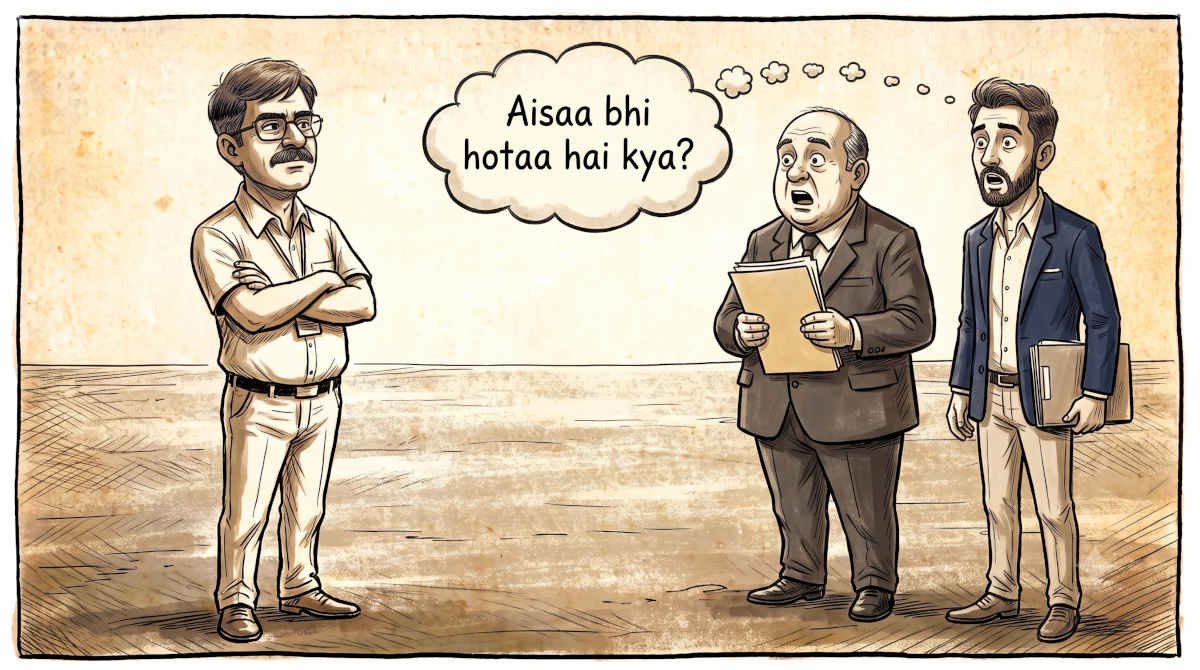
"Kaun si waali?" I wondered. He was in fact my favourite for his technical presentation, but they were not even L-3. Bad luck for them. "Wohi corruption waali. Management did not believe that no layer wanted to make money. They said "Aisaa bhi hotaa hai kya?" The commercial team inflated the bid, otherwise we were ready to bid Rs 63.5, Sir!"
That's when I observed philosophically. "That's why, like Justice, transparency should also be seen to be done. You should have believed us."
कैसे मान लेता. You were the exception that proves the rule. In costing exceptions do not get factored in.